Break the checking loop. Build real self-trust.
If anxiety, intrusive thoughts or OCD-like doubt make you keep rechecking doors, stoves, windows or meds, CalmCheck gives you visual proof and AI guidance so you can finally trust yourself.
CalmCheck is a self-help companion and does not replace professional diagnosis or therapy.
Remember: Front Door
Locked at 08:21 AM
You locked the door at 08:21. It's safe to leave it as it is.
≈40M U.S. adults (≈19% per year) live with an anxiety disorder.
OCD affects about 2.3% of adults; many more have subclinical checking behaviours.
Checking, counting and reassurance are among the most common compulsions.
Mental health apps are already used by tens of millions of people worldwide.
You're not 'crazy'. Your brain is stuck in a loop – and loops can change.
What's Happening in Your Brain
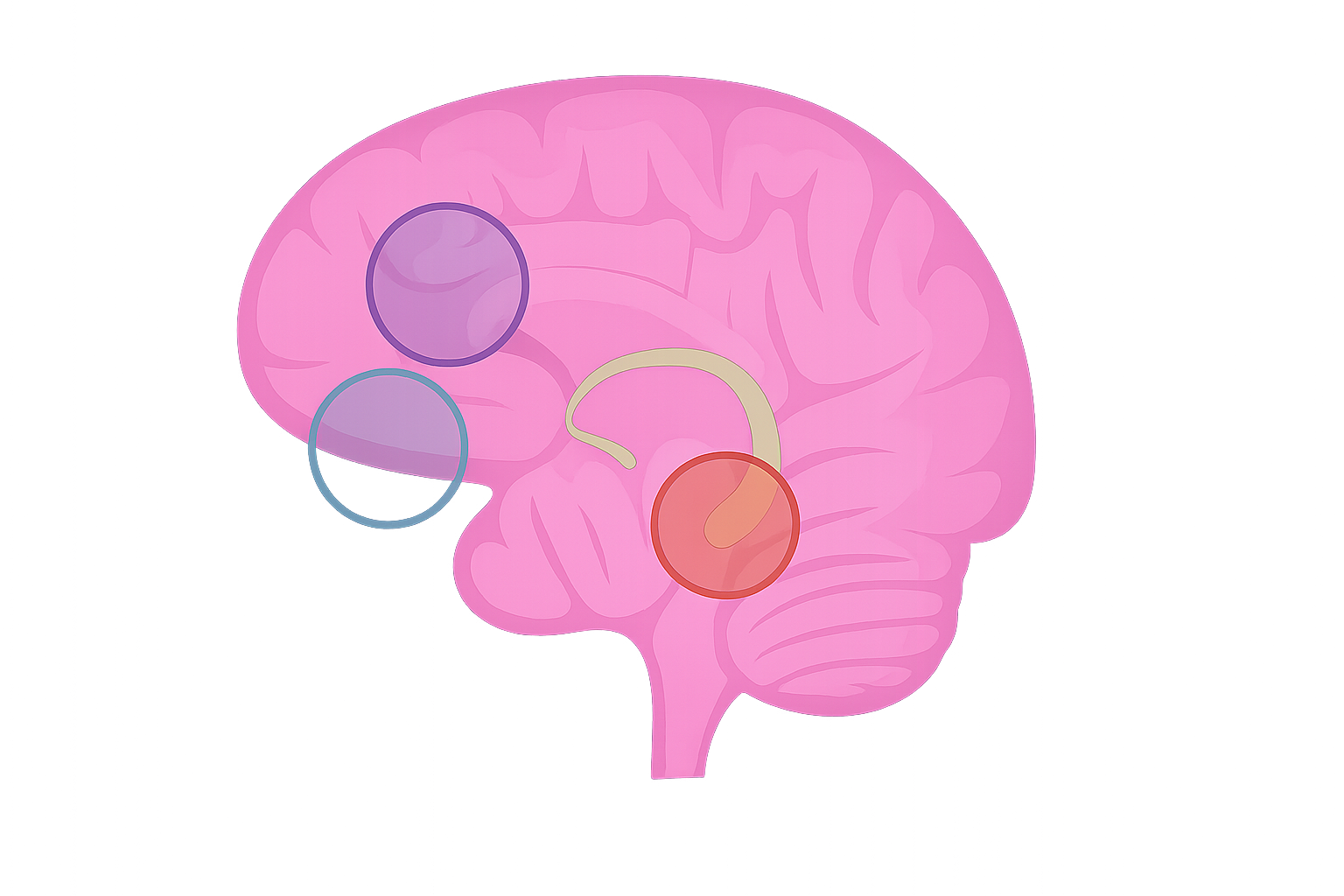
Checking behaviours arise from a disruption in the brain's uncertainty-processing circuit, mainly involving three regions:
- Amygdala – generates fear and threat signals.
- Orbitofrontal cortex (OFC) – evaluates whether something feels safe or complete.
- Anterior cingulate cortex (ACC) – signals that something feels "not right".
When these systems become hyperactive—due to anxiety, intrusive thoughts, hypervigilance, or intolerance of uncertainty—the brain struggles to trust its own memory, creating a persistent sense of doubt ("Did I lock the door?").
Each time you recheck, the anxiety drops for a moment, teaching the brain that checking = relief. That relief reinforces the loop and makes the urge to check even stronger.
The brain creates the loop – but with the right tools and repeated practice, the loop can be broken.
How CalmCheck Helps Break the Loop
Four core features designed to help you trust yourself again
Visual Proof System
One-tap capture of a photo + note when you lock, switch off or take meds. Organised into categories (Door, Car, Stove, Windows, Meds, Devices, Custom). Later, when doubt appears, you open CalmCheck instead of re-doing the action.
AI Coach
24/7 conversational coach grounded in CBT-style patterns for anxiety & OCD-like behaviours (not therapy, but structured psychoeducational support). Context-aware prompts that recognise spikes in checking and suggest healthier responses.
Insights Dashboard
Charts for checking frequency over time (daily/weekly/monthly). Breakdowns by situation (leaving home, going to bed, etc.). "Trust milestones" when users successfully don't check and feel okay.
Trust-Building Journey
Gradual weaning flows: "10 checks → 3 checks → 1 check → no check." Small experiments to practice tolerating uncertainty. Goal: decrease compulsive checking, while increasing long-term self-trust and wellbeing engagement
How It Works in 3 Steps
Capture Once
Take a quick photo or note when you lock, switch off, or finish a task.
Trust the Proof
When doubt hits, open CalmCheck instead of going back. See the photo, timestamp and AI reminder.
Train Your Brain
Over time, the app helps you skip some checks and celebrates self-trust wins, teaching your brain that not checking is safe.
Who It's For
Checking anxiety
doors, stoves, irons, taps, windows, car locks, etc.
OCD-like compulsions
people with or without a formal diagnosis whose main problem is checking and reassurance.
Hypervigilance & chronic doubt
rereading messages, rechecking tasks, asking others for reassurance over and over.
CalmCheck is a self-help companion and does not replace professional diagnosis or treatment. If you're in crisis, please contact local emergency services or a crisis hotline.
Built on Science, Powered by Modern Tech
Grounded in evidence-based principles from cognitive behavioural therapy (CBT) and exposure work used for anxiety and OCD-like patterns.
Informed by modern neuroscience on how the brain processes fear, uncertainty and error signals.
Designed to help reduce compulsive checking and strengthen long-term self-trust using safe, supportive guidance and top-tier AI technology.
Why CalmCheck is Different
Focused
built specifically for checking anxiety, not generic mindfulness.
Practical
visual proof + guidance instead of only meditation tracks.
Designed to fade out
the goal is to reduce unhealthy checking behavior.
Meet the Founder
Andrei Tihoc
Founder & Developer
I'm Andrei Tihoc, 18 year-old, founder and National Olympiad competitor in Cyber Security, AI, Physics, and Astronomy & Astrophysics. I made CalmCheck because I kept meeting people quietly suffering from checking anxiety and feeling alone in it.
I love technology, but even more, I love when technology actually reduces human pain. That's why I built this—fast, focused, and with one mission: help people trust their own minds again.